

If you print at home, you have almost certainly heard the name SUNLU. It shows up on spool bundles, in filament dryer recommendations, and in the “what should a beginner buy” threads that never stop rolling. So the one question most 3D-printing buyers actually have is simple: is SUNLU good enough for real projects, or is it just cheap? After digging through years of hobbyist feedback, spec sheets, and the brand’s own catalogue, the honest answer is that SUNLU is one of the best value plays in desktop 3D printing right now, with a couple of caveats you should know before you fill a cart.
This review covers SUNLU’s core filaments (PLA, PLA+, PETG, silk and specialty lines), its resins, and the FilaDryer hardware that turned the brand from “budget filament seller” into an ecosystem. We keep it honest: genuine strengths, the real drawbacks, and who should skip it.
PrimeVouch Score: 8.4 / 10
Best for: Beginners and high-volume hobbyists who want reliable, low-cost PLA/PETG plus an affordable filament-drying ecosystem, and who are comfortable dialing in their own slicer settings.
What we loved:
- Excellent price-per-kilogram, with bundle discounts that push the cost down further
- Standard PLA and PLA+ that print cleanly on almost any machine, from Enders to Bambu
- A genuinely wide catalogue: matte, silk, rainbow, wood, glow, carbon-fiber, TPU and more
- The FilaDryer S-series, which is one of the most recommended budget drying solutions
- Cardboard-free, tidy winding on most spools and solid dimensional tolerance for the price
Watch out for:
- Batch-to-batch consistency can vary; an occasional spool underperforms
- Customer support has a mixed reputation, so buy where returns are easy
- Exotic and engineering lines need more tuning than the marketing implies
- It is value-grade, not a boutique premium filament, and it is fair to judge it as such
What makes SUNLU different
SUNLU has been making 3D-printing consumables for over a decade, and that longevity shows up in two ways. First, scale: the company produces filament in enormous volume, which is the main reason a kilogram of SUNLU PLA routinely lands near the bottom of the price chart while still printing well. Second, breadth: SUNLU did not stay a filament company. It expanded into resins, filament dryers, dry boxes, an AMS heater aimed at Bambu Lab owners, curing boxes and connectors. The result is a brand you can build most of a hobby workflow around without shopping five different stores.
The strategic difference that matters most to buyers is that SUNLU treats moisture as a first-class problem. Cheap filament is only cheap if it prints well, and the number one reason budget filament prints badly is water absorption. By selling affordable dryers alongside the spools, SUNLU quietly solves the failure mode that sinks most low-cost filament. That pairing, cheap material plus cheap drying, is the real story of the brand.
None of that makes SUNLU a premium boutique label. It competes on value, and it should be judged on value. Within that lane it is one of the strongest options available, which is why it keeps getting recommended to newcomers. If you want to see current pricing across the range, you can Shop SUNLU deals and compare bundles directly.
The star product: SUNLU PLA and PLA+
If SUNLU has a hero product, it is not a single spool, it is the plain PLA and PLA+ that form the backbone of the catalogue. This is the filament that earns the brand its reputation, and it is the easiest recommendation we can make.
Standard SUNLU PLA is forgiving. It flows smoothly, sticks to the bed without drama, tolerates imperfect leveling better than most competitors in its price band, and produces clean layer lines with vibrant, accurate colors. For a beginner learning to print, that forgiveness is worth more than any spec sheet. You spend less time fighting the material and more time actually printing.
PLA+ (SUNLU also sells an upgraded PLA+ 2.0) steps up toughness. Regular PLA can be brittle and snap under stress; PLA+ adds impact resistance and a bit of flex, so functional parts, brackets, clips and anything that takes a knock hold up noticeably better. It still prints at PLA-like temperatures and ease, so it is a low-risk upgrade. For most makers, PLA+ is the sweet spot: nearly as easy as PLA, meaningfully more durable, and still cheap.
The honest caveat is consistency. The vast majority of SUNLU PLA spools print beautifully, but the most common complaint across the hobbyist community is that an occasional batch or color underperforms, with more stringing or a rougher surface than the last roll. It is not frequent, but it is the reason we suggest buying from a seller with a friendly return policy and testing a new color before committing to a big print. When you are ready to stock up, you can grab SUNLU filament here.
The rest of the range
SUNLU’s catalogue is genuinely deep. Here is how the main lines stack up.
SUNLU PETG
PETG is where SUNLU quietly shines for functional printing. It offers PLA-like ease of use with far better heat resistance, layer adhesion and durability, and without the warping and fumes of ABS or the need for an enclosure. Hobbyists love it for outdoor parts, mechanical components and anything that lives in a hot car. Expect a little more stringing than PLA; a quick dry and tuned retraction settings clean that right up.
SUNLU Silk and Multi-Color Silk
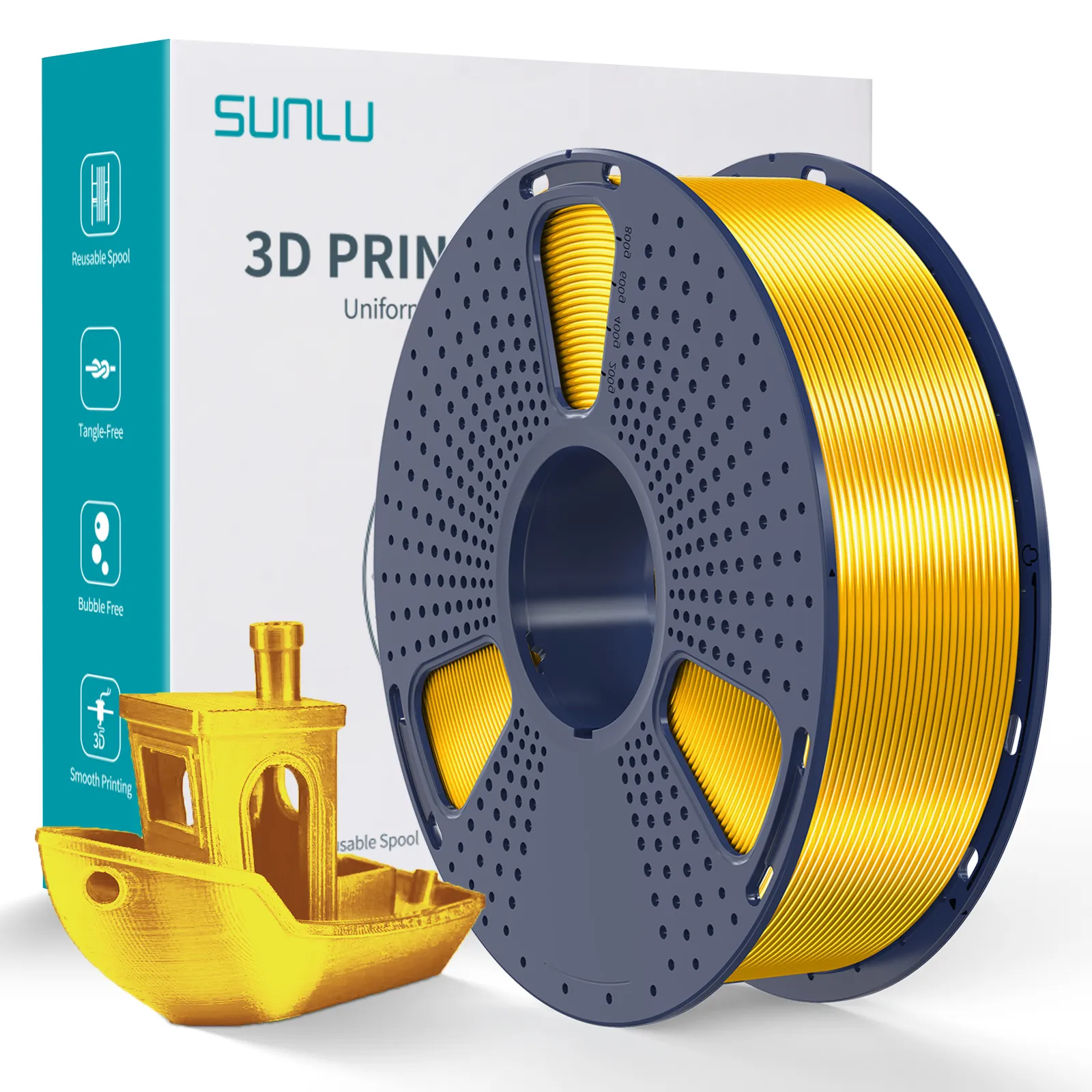
The silk lines give prints a glossy, almost metallic sheen that looks great on decorative models. SUNLU also sells dual, tri and four-color silk that transitions between shades along the spool, which lets single-extruder printers produce multi-color effects without an AMS. It is fun and eye-catching. Silk is a bit softer and can be more prone to stringing, so it rewards a little tuning, but the visual payoff is strong.
SUNLU Matte, Wood, Galaxy and Glow PLA
The esthetic range is a big part of SUNLU’s appeal. Matte PLA hides layer lines and photographs well; wood-fill has a warm, sandable finish; Galaxy and Twinkling PLAs sparkle; glow-in-the-dark options are a hit for props and toys. These specialty PLAs print at roughly standard PLA settings, though abrasive fills like wood and any carbon-fiber blend deserve a hardened nozzle.
SUNLU TPU, ASA and engineering filaments
SUNLU also stocks flexible TPU (90A and 95A), ASA for UV-resistant outdoor parts, and a growing engineering line including PLA carbon-fiber, PETG-CF, nylon (PA-CF, PA-GF), PC and even PEEK. These are more demanding materials. They can produce great results, but they need the right printer, temperatures and often drying and an enclosure. Treat the engineering range as capable-but-advanced rather than plug-and-play.
SUNLU 3D resins
For resin printers, SUNLU offers standard, water-washable, ABS-like, plant-based and tougher specialty resins. They are a sensible budget pick that cures reliably and prints crisp detail on typical LCD machines. As with any resin, ventilation, gloves and proper post-curing matter more than the brand you buy.
SUNLU FilaDryer S-series and accessories
The FilaDryer dryers are arguably as important to the brand as the filament. The S2 is the popular entry point, a single-spool dryer that heats to a strong temperature and holds it, dramatically improving print quality on any moisture-sensitive material. The larger S4 dries up to four spools at once with even airflow and is the pick for busier setups, at the cost of desk space. Around these sit the SP2 modular dryer, the E2 drying-and-annealing unit, dry boxes, a filament connector and a UV curing box. The AMS Heater, aimed at Bambu Lab owners who want to dry filament while it feeds, is one of the newer additions. You can browse the current dryer lineup and check SUNLU FilaDryer prices.
How to choose and get the best prints
Matching the filament to the job is most of the battle. Here is the short version.
- Learning to print, or making toys and models: start with standard PLA. It is the most forgiving and the cheapest.
- Functional parts that need to survive a drop or a load: PLA+ or PLA+ 2.0.
- Outdoor, mechanical, or heat-exposed parts: PETG (or ASA for heavy UV exposure).
- Looks over strength, gifts and decor: silk, matte, wood, or Galaxy PLA.
- Flexible parts, phone cases, grips: TPU 95A (easier) or 90A (softer).
To get the best results from any SUNLU spool: keep filament dry (this is the single biggest quality lever), use a hardened nozzle for wood and carbon-fiber blends, tune retraction to tame stringing on PETG and silk, and print a small temperature tower with each new material to find your machine’s sweet spot. SUNLU publishes suggested temperature ranges on each spool; treat them as a starting point, not gospel.
Watch: SUNLU in action
For a hands-on look at how SUNLU PLA performs on a modern printer, this review from a Bambu Lab user walks through real prints and print quality.
SUNLU vs alternatives
SUNLU does not exist in a vacuum. Here is how it compares to two other popular filament brands hobbyists cross-shop.
| Brand | Price position | Best known for | Trade-off |
|---|---|---|---|
| SUNLU | Budget / value | Cheap, easy PLA and PLA+, huge color range, affordable dryers | Occasional batch inconsistency; value-grade finish |
| Overture | Budget / mid | Consistent PLA and PETG, tidy spools, strong beginner reputation | Often a little pricier; smaller specialty range |
| Polymaker | Mid / premium | Tight tolerances, engineering materials, refined finishes | Costs noticeably more per kilogram |
The takeaway: SUNLU and Overture trade blows in the budget tier, with SUNLU usually winning on price and range and Overture edging ahead on batch consistency. Polymaker sits above both on quality and price. If your priority is cost-per-print and variety, SUNLU is the natural pick.
Price & value
Value is SUNLU’s entire pitch, and it delivers. Standard PLA regularly sits at the low end of the market on a per-kilogram basis, and the brand leans hard into multi-kilo bundles: buying several spools at once drops the effective price per kilogram further. Specialty lines like silk and matte cost a bit more, and engineering materials more still, but they remain competitive within their categories.
The dryers are priced the same way. Rather than treating filament drying as a premium accessory, SUNLU positions the S-series as an affordable must-have, which is why it dominates budget dryer recommendations. When you factor in fewer failed prints from dry filament, the value proposition gets stronger, not weaker. For a value brand, that is exactly the right instinct. To see live pricing and current promotions, Shop SUNLU deals.
Who should buy and who should not
Buy SUNLU if you are a beginner who wants forgiving, inexpensive filament; a high-volume hobbyist who burns through kilograms and cares about cost-per-print; someone who wants to experiment with silk, matte, wood or glow without overspending; or a maker who wants an affordable, well-regarded filament dryer.
Think twice if you need guaranteed spool-to-spool consistency for a production business, you rely heavily on demanding engineering materials and want a brand tuned specifically for them, or you want white-glove customer support and premium packaging. In those cases a pricier, more consistency-focused brand may serve you better, even at a higher cost.
Honest limits
To keep this review straight: SUNLU is a value brand, and value brands make trade-offs. The recurring, credible criticism is batch inconsistency. Most spools are great, but a minority arrive with more stringing, a rougher finish, or the occasional winding tangle, and that unpredictability is the price of the low price. Customer support also draws mixed reviews, with reports of slow responses, which is why buying through a retailer or storefront with an easy return path is smart insurance.
The exotic and engineering lines are the other honest limit. Marketing makes carbon-fiber and nylon sound turnkey; in reality they need a capable printer, careful drying, the right nozzle and patience. Judged as premium filament, SUNLU would fall short. Judged as what it is, an affordable, versatile, beginner-friendly brand, it is one of the best in its class.
SUNLU discount codes & deals
Because SUNLU competes on price, this is a brand where deals genuinely move the needle. Bundle discounts on multi-kilo filament purchases, seasonal sales and dryer promotions can meaningfully lower your cost-per-print, and stacking a filament order with a FilaDryer is often where the best combined value sits. Rather than paying sticker price, check the current offers first.
Ready to stock up? Shop the latest SUNLU deals here to see live prices on PLA, PLA+, PETG, silk and the FilaDryer range, and grab any active bundle discounts before they rotate out.
Frequently asked questions
Is SUNLU filament good for beginners?
Yes. Standard SUNLU PLA is one of the most forgiving budget filaments available. It adheres well, tolerates imperfect leveling, and prints cleanly on most machines, which makes it an ideal first filament while you learn.
What is the difference between SUNLU PLA and PLA+?
PLA is easy and cheap but can be brittle. PLA+ (and the upgraded PLA+ 2.0) adds impact resistance and a bit of flex, so functional parts hold up better under stress, while still printing at PLA-like ease. For most people PLA+ is the better everyday choice.
Do I need a SUNLU FilaDryer?
If you print PETG, TPU, nylon, or store filament in a humid environment, a dryer noticeably improves quality and reduces failed prints. The S2 is the popular single-spool entry point; the S4 handles up to four spools. Even PLA benefits from drying if it has been sitting out.
Is SUNLU consistent from spool to spool?
Mostly, yes, but not perfectly. The most common complaint is occasional batch variation, where a spool strings more or finishes rougher than the last. It is the trade-off for the low price. Buying where returns are easy is the simplest safeguard.
How does SUNLU compare to Overture and Polymaker?
SUNLU and Overture compete closely in the budget tier, with SUNLU usually cheaper and broader in range and Overture slightly more consistent. Polymaker is a step up in quality and price, better suited to demanding engineering work.
Can I print SUNLU on a Bambu Lab or Creality printer?
Yes. SUNLU PLA, PLA+ and PETG print well on Bambu, Creality, Prusa and most mainstream printers using standard profiles. SUNLU even makes an AMS Heater aimed at Bambu owners who want to dry filament as it feeds.
Is SUNLU resin worth it?
For hobbyist LCD resin printing, yes. SUNLU’s standard, water-washable and ABS-like resins cure reliably and capture crisp detail at a budget-friendly price. As always with resin, ventilation and proper post-curing matter as much as the brand.
Filament storage and moisture: the setting that fixes most bad prints
Here is the single most useful thing to understand about any budget filament, SUNLU included: most “bad filament” is actually wet filament. PLA, and especially PETG, TPU and nylon, absorb moisture from the air. When that water hits the hot nozzle it flashes to steam, causing popping sounds, stringing, bubbles, weak layers and a rough surface. People blame the brand when the real culprit is humidity.
The fix is storage and drying. Keep spools in sealed containers or dry boxes with desiccant when you are not using them, and dry moisture-sensitive filament before big prints. That is exactly why SUNLU’s affordable FilaDryer line matters so much: cheap filament only stays cheap if it prints well, and dry filament is the difference between a spool that disappoints and one that performs. A rough rule of thumb is to dry PLA gently and lower, PETG and TPU warmer, and nylon warmest, following the guidance on the spool and in the dryer manual.
Do this one thing, control moisture, and SUNLU’s value proposition holds up remarkably well. Skip it, and even premium filament will let you down. If you want to pair a fresh filament order with a dryer, you can shop SUNLU filament and FilaDryer deals here and set yourself up for consistent prints from day one.