
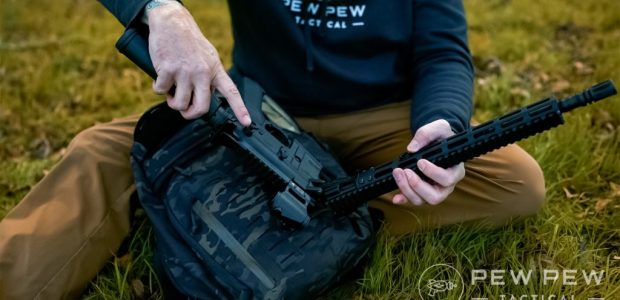

If you found your way here, you are almost certainly asking one specific question: is a rifle that folds in half a genuinely useful tool, or a gimmick that trades away accuracy and reliability for a party trick? That is the honest question at the heart of any FoldAR purchase. FoldAR (foldar.com) builds ultra-compact folding AR-15 rifles, complete folding upper receivers, and a patented quick-detach barrel system, all designed and manufactured in Henderson, Texas by a veteran-owned company. The core promise is bold: a full-capability AR-15 with a real, full-length barrel that folds down to under 18 inches so it can ride in a backpack, a vehicle, or a small safe, then deploy in seconds and shoot like a normal rifle.
We dug into FoldAR’s product line, independent range reviews, competition results, and buyer feedback to figure out whether the folding hinge is engineering worth paying for. The short version: this is one of the rare “novel” firearms that actually holds up under scrutiny. But it is also expensive, niche, and not for everyone. Here is the full breakdown.
PrimeVouch Score: 8.6 / 10
Best for: People who want a serious, full-capability AR-15 that stores and travels in a fraction of the normal footprint. Think preppers, truck-gun owners, backpack-carry advocates, protective details, school resource officers, and gear enthusiasts who value modularity and are willing to pay a premium for it.
What we loved:
- The folding hinge is not a gimmick. Independent reviewers reported sub-MOA groups and zero malfunctions across hundreds of rounds.
- Return-to-zero. Testers broke the rifle down, reassembled it, and kept printing tight groups.
- Genuinely compact. Models fold to under 18, 15, 14, and even 12 inches depending on configuration.
- Modular quick-detach barrel system lets you swap barrels and calibers without tools.
- Made in Texas, veteran-owned, with a lifetime warranty and standard mil-spec parts commonality.
Watch out for:
- Price. Complete rifles generally run in the $2,300 to $2,800 range, well above a standard AR-15.
- It is a serialized firearm, so it must ship to an FFL and you must pass a background check. Short-barrel and suppressed configurations add NFA paperwork, tax stamps, and wait times.
- Availability and legality vary by state. This is not something everyone can legally buy or own.
- The added hinge, latch, and hardware make it heavier and more mechanically complex than a bare-bones AR.
What makes FoldAR different
Almost every attempt to make a rifle “compact” runs into the same wall: barrel length. A longer barrel builds more velocity, which means better downrange performance, so shortening the barrel to shrink the gun quietly degrades the very thing that makes a rifle worth carrying. Standard AR-15s can be broken into two pieces by pushing out the takedown pins, but you are still left with a roughly two-foot-long assembly of barrel, handguard, and upper receiver. That is not concealable in any meaningful sense.
FoldAR’s answer is a patented hinge (US Patent No. 9,995,556) located near the barrel-breech interface of the upper receiver. Instead of shortening the barrel, the entire handguard and barrel fold back alongside the receiver. When you deploy the rifle, a hook-and-lever latch pulls the two halves together and locks them tight, which matters a great deal given the chamber pressures involved in firing. The result is a rifle that keeps a real, full-length barrel yet collapses to a footprint that fits in a daypack.
Layered on top of that hinge is FoldAR’s Quick-Detach Barrel System, marketed as “One Rifle to Rule Them All.” Using a proprietary barrel takedown pin, it lets you swap barrels, and therefore calibers and barrel lengths, in seconds without tools. Combined with the folding upper, that turns a single serialized lower into a genuinely modular platform. The rest of the rifle is deliberately conventional: standard AR-15 controls, mil-spec component commonality, a forged 7075-T6 chassis, hammer-forged Melonite barrels, an adjustable low-profile gas block, and M-LOK handguards. That “novel where it counts, standard everywhere else” philosophy is a big part of why the platform works. Shop FoldAR deals.
The star product
If there is a single flagship in the lineup, it is the FoldAR Watchman. It is the full-length duty rifle in the family, built for maximum reach, stability, and precision, and it still folds to under 18 inches overall, which makes it backpack-ready. FoldAR positions it for patrol, home defense, and general-purpose use, and it deploys in under two seconds. It also carries a serious competition credential: a FoldAR Watchman took First Place Overall in the 2025 SIG SAUER Relentless Warriors Championship, and Texas A&M cadets famously used FoldAR rifles to win at that same event. Winning a demanding, physical shooting competition is about the strongest real-world proof of reliability and accuracy a folding rifle could ask for.
The Watchman is the model most buyers should look at first, because it delivers the platform’s full ballistic performance with the least compromise. It is the configuration that best answers the “does it still shoot like a real rifle” question, and the answer, based on both competition results and independent range testing of the platform, is a confident yes. It typically sits in the $2,399 to $2,499 range depending on configuration. If you want one rifle that captures everything FoldAR is about, this is it. Shop FoldAR deals.
The rest of the range
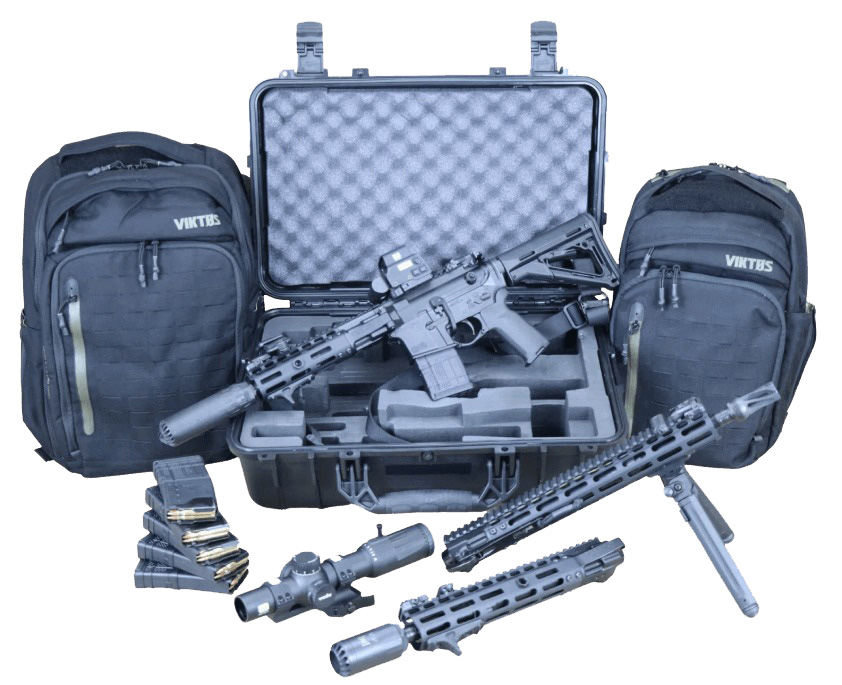
FoldAR’s lineup is essentially a spectrum from “full-length and capable” to “smallest AR that can physically be built.” As you move down the range, overall folded length shrinks and the intended use shifts toward deep concealment and confined spaces. Here is how the family breaks down.
Shepherd
The Shepherd is the suppressor-ready middle child, balancing concealability against performance. With a compact suppressor installed it folds to under 15 inches. FoldAR pitches it squarely at School Resource Officers, vehicle carry, and rapid-response roles, where a rifle that does not look intimidating but can be deployed fast has obvious appeal. It deploys in under two seconds and typically runs $2,399 to $2,499. The 9-inch suppressed Shepherd is one of the most talked-about configurations in the brand’s own media.
Sentinel
The Sentinel is an ultra-compact configuration optimized for confined spaces, folding to under 14 inches with a compact suppressor. FoldAR designed it for CQB, protective details, and tight environments. It deploys in under three seconds and sits at roughly $2,599. If your primary concern is maneuverability inside vehicles and structures rather than maximum barrel length, the Sentinel is the sweet spot.
Remnant
The Remnant pushes toward extreme compactness, folding to under 12 inches with a compact suppressor. It is built for deep concealment, backpack carry, and last-ditch readiness, deploys in under four seconds, and typically runs $2,699 to $2,799. This is where the trade-off between size and barrel length becomes most pronounced, so it is a deliberate choice for buyers who prioritize concealment above all.
nano-Remnant
The nano-Remnant is the headline act: FoldAR describes it as the most compact AR that can be manufactured. With a 7.5-inch suppressed barrel and a folding grip installed, it collapses to roughly 12 by 5 by 4 inches, small enough for fanny-pack-sized storage and transport. Introduced in March 2026 at around $2,799, it is more a statement of engineering ambition than a general-purpose rifle, but for the “smallest possible” use case it is unrivaled.
Complete Uppers and Barrel Systems
Beyond complete rifles, FoldAR sells the Complete Folding Upper on its own. It is fully assembled and compatible with standard AR lowers, so if you already own an AR-15 lower you can add the folding capability and tool-less barrel swaps without buying a whole new rifle. The Quick-Detach Barrel System is also sold as a component, letting existing owners expand into additional calibers and barrel lengths. These are the smart entry points for anyone who wants the technology without the full sticker price.
How to choose and get the best results
Choosing the right FoldAR comes down to being honest about how you will actually use it. If you want a do-everything rifle that shoots like a full-size AR and only occasionally needs to disappear into a bag, buy the Watchman. If your use case is a vehicle, a school, or a protective role where a shorter, suppressed package matters, the Shepherd or Sentinel make more sense. If deep concealment is the entire point and you accept the ballistic trade-offs of a very short barrel, the Remnant or nano-Remnant are the tools for that job.
A few practical tips. First, budget for the ecosystem, not just the rifle: an optic, a quality backpack, magazines, and, for suppressed models, the suppressor and its tax stamp. Second, plan around the mil-spec charging handle rather than replacing it, since aftermarket handles can create clearance problems when the rifle is folded. Third, practice the fold-and-deploy motion until it is second nature. Finally, if you want caliber flexibility, buy into the Quick-Detach Barrel System early.
Watch: FoldAR in action
Rather than take marketing claims at face value, it helps to watch an independent reviewer put the rifle through its paces on the range. In this hands-on review, Sean Curtis of Pew Pew Tactical, a retired law enforcement officer and SWAT team leader, tests the folding mechanism, runs accuracy strings at distance, and breaks the rifle down and reassembles it to see whether it holds zero.
FoldAR vs alternatives
FoldAR occupies an unusual niche, so its competition is really about the different ways people try to solve the “compact but capable” problem. Here is how the main approaches compare.
| Option | How it goes compact | Best for | Trade-offs |
|---|---|---|---|
| FoldAR (folding AR-15) | Patented hinge folds a full-length barrel alongside the receiver | Backpack carry with full rifle performance and modular barrel swaps | Premium price ($2,300+), added weight and complexity, FFL and possible NFA paperwork |
| AR pistol / SBR (short barrel) | Uses a very short barrel and brace or stock | Compact home-defense and truck guns on a lower budget | Shorter barrel means less velocity; SBR requires a tax stamp; still fairly long when assembled |
| Takedown rifle (e.g. AR-7 style) | Disassembles into parts for storage | Ultralight survival and packability at low cost | Usually smaller calibers and lower capability; requires reassembly before use |
The honest takeaway: nothing else gives you a full-length barrel, standard AR ergonomics, and a genuinely small folded footprint in one package the way FoldAR does. You pay for that, but the capability is real.
Price and value
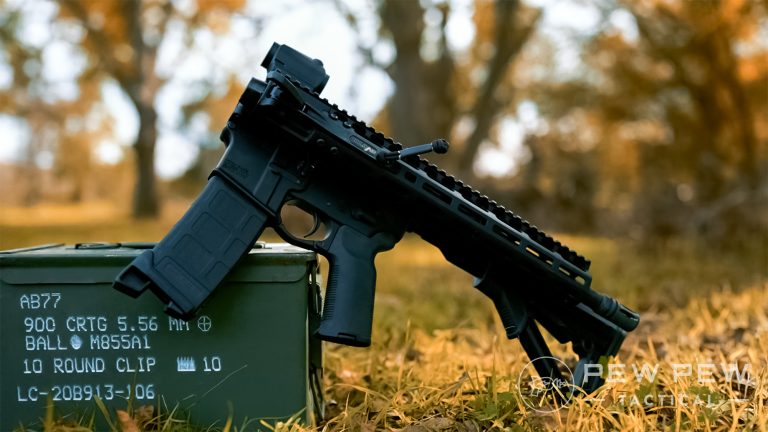
There is no getting around it: FoldAR is expensive. Complete rifles generally run between roughly $2,300 and $2,800, which is two to three times the cost of a solid standard AR-15. The Watchman and Shepherd sit around $2,399 to $2,499, the Sentinel around $2,599, and the Remnant and nano-Remnant push toward $2,700 to $2,800. FoldAR does offer financing through Credova, advertising monthly payments as low as around $67, which softens the upfront hit for buyers who want to spread the cost.
So is it worth it? The value calculation is not about price per pound of steel; it is about what the folding hinge and quick-detach barrel system enable. If compact storage and transport genuinely change whether you can keep a capable rifle, that is worth real money. If you would just leave it in the safe like any other AR, the premium is harder to justify. What tips the scales in FoldAR’s favor is that performance is not compromised to achieve the compactness, backed by a lifetime warranty and Made-in-Texas manufacturing. Veterans and first responders can also register for exclusive discounts. Shop FoldAR deals.
Who should buy, and who should not
You should strongly consider a FoldAR if you want a full-capability AR-15 that stores and travels small, if you value modularity and being able to swap barrels and calibers, if you are a prepper, backpack-carry advocate, or someone in a protective, patrol, or school-security role, and if the premium price fits your budget. It also makes sense if you already own an AR lower and want to add folding capability through the Complete Upper rather than buying a whole new gun.
You should probably skip it if you simply want an affordable, capable rifle and compactness is not a real requirement, because a standard AR-15 will do that job for far less money. Skip it, too, if you are not prepared for the reality that this is a serialized firearm requiring an FFL transfer and a background check, or if you live somewhere that restricts AR-pattern rifles, short barrels, or suppressors. And if you are chasing appendix-style concealed carry on your body, this is not that; even folded, it is a rifle that lives in a bag, not on your belt.
Honest limits
Here are the caveats worth stating plainly. First, the added hinge, latch, and locking hardware make a FoldAR heavier and more mechanically complex than a stripped-down AR; more parts is always more that can wear or need service, even if independent testing showed excellent reliability. Second, the shorter models buy their compactness with barrel length, and short barrels give up velocity, which is a real ballistic trade-off. Third, suppressed and short-barrel configurations pull you into NFA territory with tax stamps and wait times. Fourth, this is a niche, premium product, so resale and local dealer availability may be more limited than for mainstream rifles. None of these are dealbreakers for the right buyer, but walk in with clear eyes.
FoldAR discount codes and deals
FoldAR does not typically run the kind of splashy percentage-off sales you see from big-box retailers, and we are not going to invent a coupon code that does not exist. What it does offer is more durable value: verified discounts for military members and first responders (registered through a verification service), Credova financing for those who prefer to pay monthly, and a lifetime warranty that protects your investment over the long haul. Configurations, pricing, and any current promotions change over time, so the smartest move is to check the live lineup and see which model and options fit your needs and budget right now. Ready to see current FoldAR pricing and configurations? Shop FoldAR deals and compare the full range in one place.
Frequently asked questions
Is the FoldAR folding mechanism actually reliable and accurate?
Yes, based on independent testing and competition results. A reviewer at Pew Pew Tactical ran over 500 rounds with zero malfunctions and printed sub-MOA groups, including a best group under 0.6 inches, even after repeatedly folding and reassembling the rifle. A FoldAR also won First Place Overall at the 2025 SIG SAUER Relentless Warriors Championship, which is strong real-world validation.
Does the rifle hold zero after folding and unfolding?
In independent testing it did. The reviewer deliberately broke the rifle down and reassembled it between accuracy strings and continued to shoot tight, repeatable groups, which is exactly the return-to-zero behavior FoldAR advertises.
How much does a FoldAR cost?
Complete rifles generally run from around $2,399 for the Watchman and Shepherd up to roughly $2,799 for the Remnant and nano-Remnant, with the Sentinel around $2,599. Financing through Credova is available for buyers who prefer monthly payments.
Do I need any special paperwork to buy one?
Yes. A FoldAR is a serialized firearm, so it ships to a licensed FFL dealer and you must pass a background check to take possession. Suppressed and short-barreled configurations additionally fall under NFA rules, which means a tax stamp and extra processing time. Legality also varies by state.
Can I add FoldAR capability to an AR-15 I already own?
Yes. FoldAR sells a Complete Folding Upper that is compatible with standard AR lowers. That lets you add the folding hinge and tool-less barrel swaps to an existing lower without buying an entire new rifle, which is often the most cost-effective way into the platform.
Which FoldAR model should a first-time buyer get?
For most buyers, the Watchman is the best starting point. It offers the fullest ballistic performance with the least compromise, still folds to under 18 inches, and is the model with the strongest competition track record. Move to the Shepherd, Sentinel, or Remnant only if a shorter, suppressed, more concealable package specifically fits your use case.
Understanding compact and folding rifles: a quick primer
To appreciate what FoldAR is doing, it helps to understand the long history of trying to make rifles smaller. FoldAR traces the “one rifle” concept to a 1920 patent. The most famous example is the Armalite AR-7, a takedown survival rifle designed by Eugene Stoner so downed pilots could store a firearm in a small package. It was clever, but it was chambered in .22 and limited in effectiveness, the classic compromise: to make it small, designers gave up capability.
The central tension in this category is barrel length versus size. A rifle cartridge needs barrel length to build velocity, and velocity is what gives the projectile its downrange energy. Short-barrel rifles and AR pistols chop the barrel and accept the velocity loss. Takedown rifles break the gun into pieces you reassemble before use. FoldAR’s approach is arguably the most elegant: keep the full barrel, but fold it out of the way, so nothing about the rifle’s ballistics is sacrificed. The cost of that elegance is mechanical complexity and price.
Why does this matter to a buyer? Because the compact rifle you choose should match the compromise you are willing to make. If you never need the gun to disappear, a standard rifle is cheaper and simpler. If you need genuine performance in a package that stows in a backpack, folding is the only approach that does not force you to give up barrel length, which is precisely the niche FoldAR was built to own. That is why a folding design, done well, is more than a novelty. If that trade-off sounds right for you, take a look at the current lineup. Shop FoldAR deals.