

Educational review — methylene blue interacts with common medications (notably antidepressants/MAO pathways). Consult a healthcare professional before use.
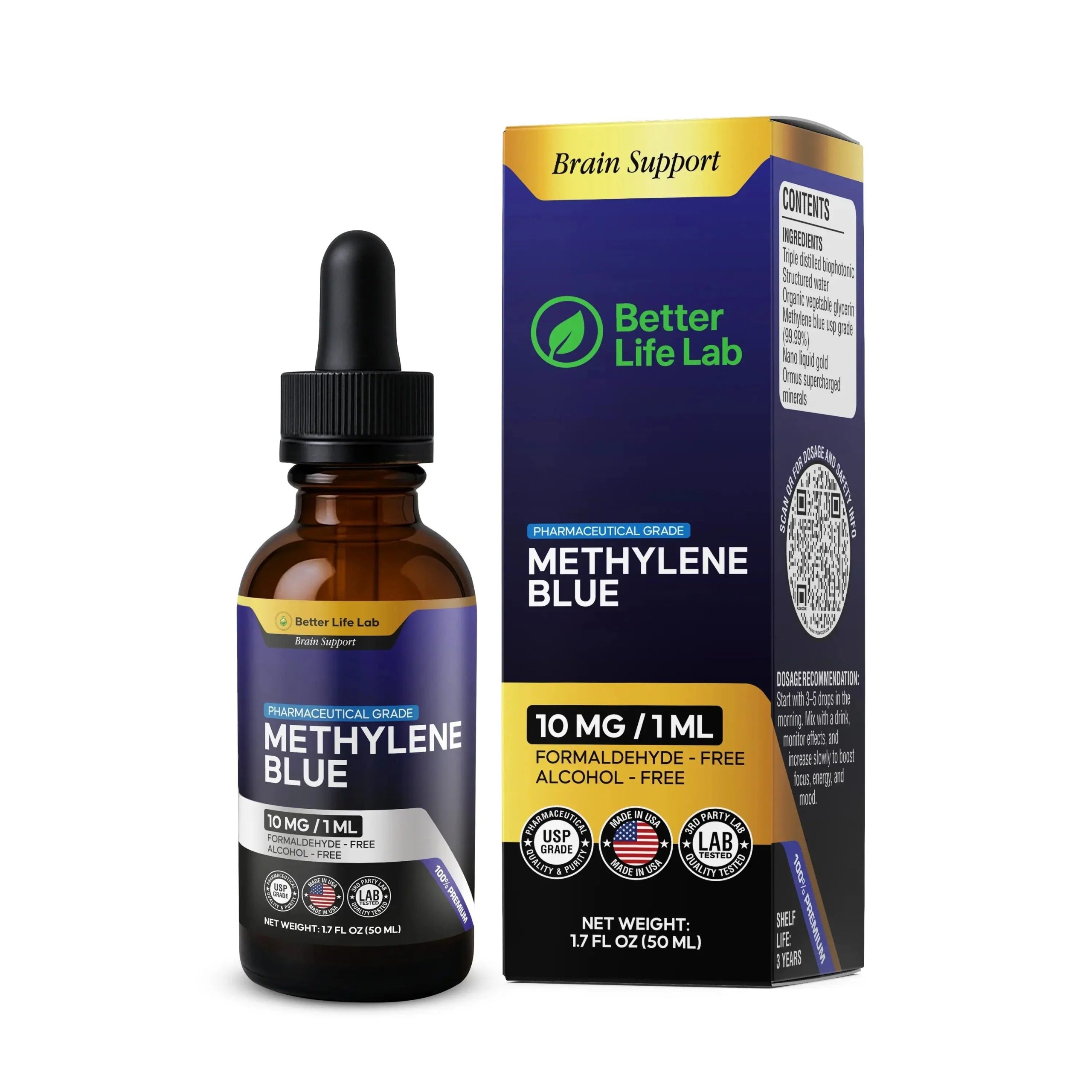
Better Life Lab rides the most-discussed molecule in longevity circles: USP pharmaceutical-grade methylene blue (99%+ purity), offered as tinctures and capsules alongside NAD+ boosters, collagen peptides and recovery formulas. The pitch is purity discipline in a compound where industrial-grade contamination is the documented category hazard — plus a Medical Advisory Board (a Yale-trained neurosurgeon and clinical pharmacist among them) reviewing the line.
The molecule's buzz — mitochondrial support, focus, cellular energy — comes from genuine research interest amplified by podcast culture (Huberman coverage included). The honest frame: promising mechanisms, evolving human evidence, real interaction risks. A brand selling it responsibly must nail purity and dosing clarity; Better Life Lab's USP standard and 30,000-customer base suggest it takes the assignment seriously, though a scam-detector's low-trust flag on the young domain warrants standard new-brand diligence.
Our verdict: Better Life Lab is a credible purity-first source for a compound that demands exactly that — with the buyer's homework (medical clearance, conservative dosing) being non-negotiable. Score: 7.5 / 10.
→ Shop Better Life Lab — see today’s best offer
What makes Better Life Lab different
USP-grade sourcing is the headline: pharmaceutical-purity methylene blue versus the industrial/aquarium-grade material that contaminates the category with heavy metals — the single most important variable in this molecule's retail story. Medical oversight: an advisory board reviewing formulations and claims, with the brand explicitly avoiding unsubstantiated promises. US manufacturing: FDA-registered, GMP-certified facilities across the line.
The star: methylene blue tincture
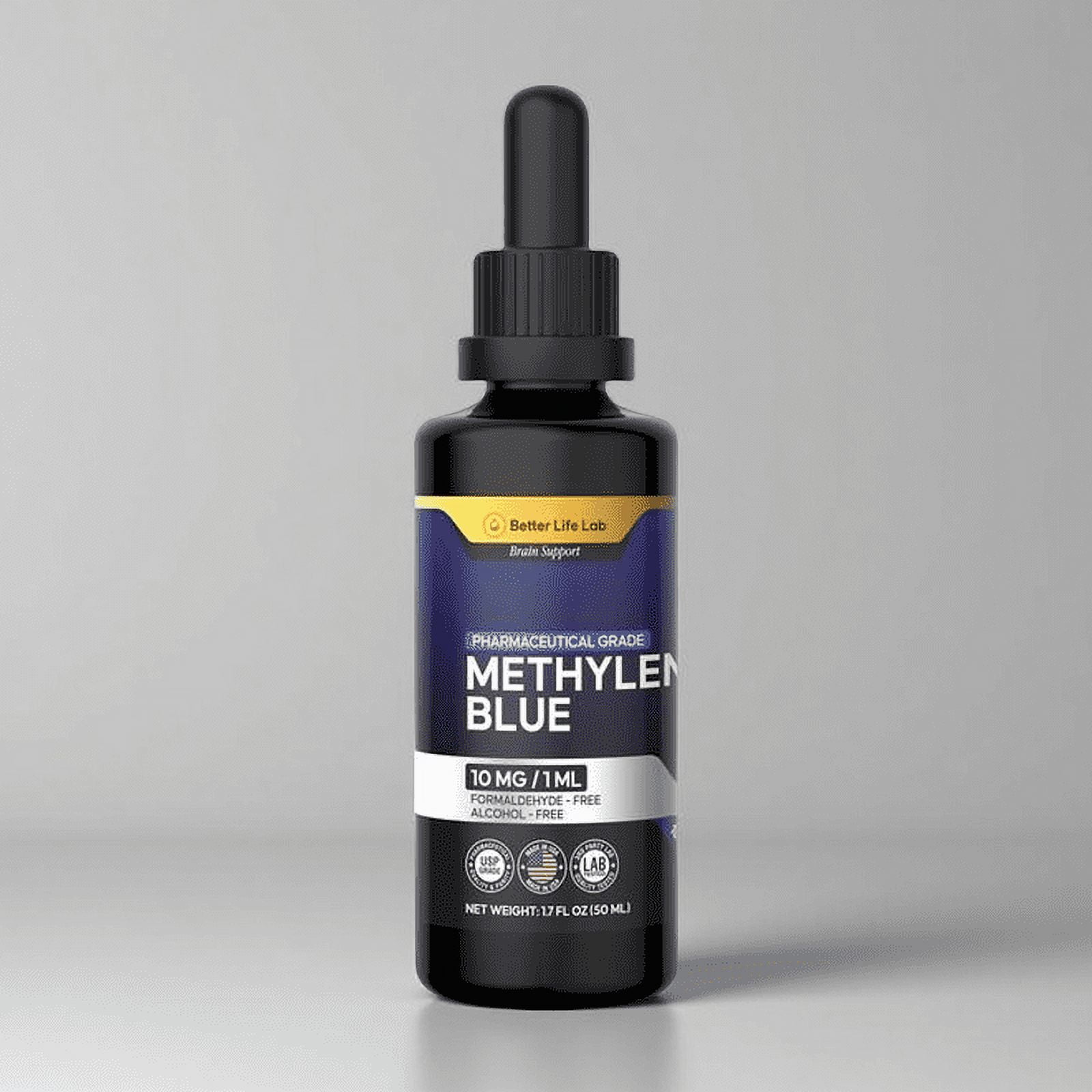
The dropper-format tincture enables the low-and-slow dosing the compound's research profile counsels — sub-milligram-per-kilogram territory where the mitochondrial-support literature operates. Users report the expected signatures: subtle focus lift, blue-tinted… everything it touches (the molecule is a dye; the smurf-tongue phase is universal), and the urine tint that startles the unbriefed. Capsules serve the dose-consistency crowd.
The rest of the range
NAD+ support, collagen peptides, hangover-recovery and longevity formulas — the adjacent stack for the same optimisation audience, produced under the same facility standards. The catalogue stays disciplined around the cellular-energy thesis rather than sprawling.
Price & value
Premium versus bulk-chemical routes — deliberately. The value case is purity verification: USP-grade material, tested production, dosing guidance — the delta between supplement and science experiment. In this molecule specifically, cheap is the expensive option.
| Product | Role |
|---|---|
| MB tincture | Flexible micro-dosing |
| MB capsules | Fixed-dose consistency |
| NAD+/recovery lines | Adjacent stack |
→ Get the latest Better Life Lab deal
How to approach it responsibly
Medical clearance first — the MAO-pathway interaction with SSRIs/SNRIs is the serious one, and serotonergic medication plus methylene blue is a documented emergency-room combination. Start at the label's lowest dose; the compound's hormetic profile means more is not better. Log subjective effects honestly across weeks. And source purity or abstain — this review's existence assumes the first option.
Common mistakes
Skipping the medication audit (the cardinal one); megadosing on podcast enthusiasm; industrial-grade bargain hunting; expecting stimulant sensations from a mitochondrial compound; and staining everything porous — dedicated glassware and careful dropper technique are day-one lessons.
Vs alternatives
Against compounding pharmacies: comparable grade, no prescription friction, less individualised guidance. Against bulk chemical suppliers: the purity chasm — no contest for ingestion. Against other retail MB brands: the USP claim plus advisory board is the differentiation; verify certificates per batch as diligence.
Quality, shipping & support
FDA-registered, GMP-certified production; 98% reported satisfaction across a claimed 30,000+ customers; global shipping with easy-return policy. The young-domain trust-flag counsels ordinary caution: card payment, first-order small, certificates requested — the hygiene any new supplement vendor earns.
What users say
Reported wins: afternoon focus without stimulant edge, workout-recovery impressions, the energy-floor lift the mitochondrial thesis predicts. Reported honestly: effects are subtle and cumulative, the blue aesthetic is a lifestyle, and non-responders exist as with every compound.
Who should buy — and who should not
Consider it if you are medication-clear, research-literate, and want the purity-verified version of a compound you have already decided to trial responsibly.
Avoid it if you take serotonergic or interacting medications, are pregnant/nursing, have G6PD deficiency, or want proven-blockbuster evidence before experimenting — this molecule is promising, not proven.
Honest limits
Human trials remain early and small; benefits are supported, not established. Interactions are genuinely dangerous, not fine-print theatre. And no purity standard converts an experimental compound into a vitamin. The brand's restraint in claims deserves matching restraint in expectations.
The methylene blue research picture, honestly summarised
The molecule's scientific biography is genuinely unusual: a 19th-century textile dye turned antimalarial turned FDA-approved treatment (for methemoglobinemia, at clinical doses) now circling back as a longevity candidate. The modern interest rests on its electron-cycling behaviour in mitochondria — at low doses it can act as an alternative electron carrier, supporting ATP production particularly in stressed cells, which is the mechanism behind the cognitive-support hypotheses. Human trials exist but run small: memory-consolidation studies, neuroimaging work showing altered brain network activity, and early neurodegeneration research — promising signals, not established medicine.
The hormetic dose curve is the field's central warning: benefits appear at low doses while higher doses invert into pro-oxidant territory — more is actively worse, which makes the supplement-culture instinct to escalate uniquely dangerous here. This is why credible vendors emphasise conservative dosing and why the tincture format's titration flexibility matters. Buyers should internalise the shape: this molecule rewards restraint and punishes enthusiasm, pharmacologically.
Purity grades decoded: USP versus the grey market
The grade taxonomy is the entire safety story. Industrial/chemical-grade methylene blue — the aquarium and laboratory stock — legally carries heavy-metal contamination (arsenic, lead, cadmium) at levels irrelevant to dyeing fish tanks and highly relevant to human ingestion. USP (United States Pharmacopeia) grade enforces 99%+ purity with strict contaminant ceilings — the standard pharmaceutical compounding requires and the delta Better Life Lab's positioning rests on. Between them sits a grey market of “lab grade” listings whose certificates deserve the scepticism their prices invite.
Verification hygiene for any vendor in this space: batch-specific certificates of analysis on request, third-party testing claims that name the lab, and dosing guidance that respects the hormetic curve rather than promising more-is-more. The brand's advisory-board structure and claim restraint check these boxes publicly; the buyer's certificate request completes the diligence privately. In a compound where the cheap alternative is literally aquarium treatment, the premium is the product.
Stacking and lifestyle context: where MB sits in an optimisation routine
The compound's community pairings follow its mechanism: morning dosing aligns with cognitive-demand hours; light exposure synergy (photobiomodulation users often co-time red-light sessions, on early mechanistic grounds); and the standing foundations — sleep, protein, movement — that dwarf any molecule's contribution. The interaction ledger stays paramount: beyond the serotonergic hard-stop, caution extends through blood-pressure medication and G6PD deficiency, and alcohol co-timing earns avoidance on general principle.
The NAD+ and collagen lines in the same catalogue serve the same audience logic — cellular-energy adjacents for the optimisation-literate — with the same buying rules: label doses, certificate culture, and the journaling that separates signal from placebo in every n-of-1 experiment. The brand's coherence around this customer is its quiet strength; nothing in the range is impulse-shopper bait.
Red flags and green flags: vetting this category's vendors
Green flags, present here: USP-grade specificity (not vague “pure”), named medical advisors, GMP/FDA-registered facility claims that are checkable, restrained benefit language, and dosing guidance that starts low. Red flags, absent here but rampant in the category: cure-adjacent claims, influencer megadose protocols, mystery-grade sourcing, and pricing that undercuts the raw-material cost of legitimate purity. The young-domain trust-flag noted earlier slots into this framework as a neutral: age is one signal, and the countervailing signals (satisfaction rates, documented standards) outweigh it for card-protected first orders.
The category's trajectory suggests regulation will eventually formalise what diligence currently improvises; until then, the vetting checklist above is the buyer's pharmacopeia. Better Life Lab passes it as well as any retail entrant we have examined — which, stated precisely, is the review's entire claim.
The optimisation stack context: where MB sits among the longevity crowd
Methylene blue's current moment belongs to a broader cellular-energy portfolio the same buyers run: NAD+ precursors (NMN/NR) targeting the coenzyme decline of aging, CoQ10 and PQQ on the mitochondrial-support adjacent shelf, creatine's cognitive findings crossing over from the gym literature, and the photobiomodulation devices whose红-light mechanism MB users find conceptually familiar (both target the electron transport chain, which is why the community pairs them). The portfolio framing matters for budget sanity: these are marginal-gains instruments layered atop the boring foundations — sleep architecture, protein floors, zone-2 cardio — that dwarf every molecule's contribution. The optimiser's honest ledger runs foundations at ninety percent of outcomes and the stack at the enthusiast's remainder.
Vendor-selection discipline transfers across the portfolio: the USP-versus-mystery-grade decision recurs in every compound category, third-party certificates are the universal ask, and the journaling protocol this review prescribed is the only instrument that separates a working stack from an expensive placebo ritual. Better Life Lab's catalogue coherence around this buyer — MB flagship, NAD+ adjacents, recovery formulas — reads as portfolio-native retail, which is precisely its market position.
Safety architecture: the contraindication map in full
The interaction ledger deserves completeness beyond the serotonergic headline. Absolute-caution tier: SSRIs, SNRIs, MAOIs and the serotonergic family (the emergency-literature combination), G6PD deficiency (hemolysis risk — the screening question ancestry-aware buyers should know), and pregnancy/nursing (no adequate data, automatic exclusion). Professional-conversation tier: blood-pressure medications, psychiatric medications broadly, and any polypharmacy profile where a pharmacist's interaction screen costs nothing and catches everything. Practical-annoyance tier: the blue staining (dedicated glassware, careful dosing surfaces), transient urine colour (harmless, startling), and the taste that motivates the capsule format's existence.
The dosing philosophy restated as architecture: low-dose hormesis is the entire therapeutic thesis — the sub-milligram-per-kilogram lane where the mitochondrial literature operates — and escalation beyond it inverts benefits by the compound's own pharmacology. The buyer this product suits is definitionally the buyer who finds that constraint reassuring rather than disappointing; enthusiasm-dosers should not be in this category at all. Score: 7.5 / 10.
The self-experiment ethos: n-of-1 done honestly
The optimisation community's best export is its method, and MB purchases deserve it fully: single-variable introduction (no stack changes during the trial month), objective anchors where possible (reaction-time apps, workout logs, sleep trackers) alongside the subjective journal, and the pre-registered success criteria that defeat post-hoc rationalisation — decide before day one what “working” would look like. The washout test completes honest protocol: a fortnight off after the trial month, watching whether the baseline actually shifts back. Compounds that survive that full loop earn their subscription; compounds that do not saved you a year of expensive ritual. The blue molecule's visibility makes it an ideal first n-of-1 — you literally cannot forget whether you dosed. Score: 7.5 / 10.
Format decisions: tincture versus capsule in practice
The two formats serve different experimenters. The tincture's case: titration granularity (the drop-level dosing the hormetic curve rewards), cost-per-milligram efficiency, and the sublingual-adjacent absorption route users prefer for onset feel — at the price of taste (bracing), staining logistics and the measurement ritual. The capsule's case: dose consistency without ceremony, travel and workplace practicality, zero staining — at fixed-dose granularity and modest premium. The community's common arc: tincture for the calibration phase (finding the personal dose), capsules for the maintenance phase once the number is known — the two-product journey the catalogue's structure quietly anticipates.
The storage-and-handling appendix: amber glass away from light, dedicated dropper hygiene, childproofing treated as pharmaceutical (the blue attraction is real for small hands), and the label-the-shelf discipline that keeps the household informed. Small operational habits, but this molecule's entire safe-use culture is operational habit — the theme this review has not varied from. Score: 7.5 / 10.
The information diet: researching responsibly
The MB curiosity's healthiest habit is source hygiene: the clinical literature (PubMed's methylene blue corpus) over podcast enthusiasm, the pharmacology references over community anecdotes for interaction questions, and the vendor's certificates over the vendor's marketing everywhere. The red flags in content consumption mirror the product's: megadose testimonials, cure-language creators and the influencer-code economy that monetises exactly the escalation the hormetic curve punishes. Curiosity plus scepticism is the compound's correct co-supplement — cheaper than the tincture and dosed daily. Score: 7.5 / 10.
Better Life Lab discount codes & deals
First-order incentives, bundles and subscription pricing run regularly — check the current PrimeVouch listing for active codes before checkout.
FAQ
Is methylene blue safe?
At low doses, in screened individuals, with USP-grade material — the risk profile is manageable per the clinical literature. The medication-interaction screen is the gate; walk through it with a professional.
What does USP-grade mean?
United States Pharmacopeia purity standards — 99%+ purity, contaminant limits — versus industrial dye grades never intended for ingestion.
Will it turn things blue?
Yes — tongue transiently, urine reliably, porous surfaces permanently. It is a dye first, supplement second.
When would I notice effects?
Subtle focus/energy shifts within days-to-weeks at conservative doses; the journaling habit is the honest instrument.
Why the trust-flag caution?
Young domains trigger automated scanners regardless of merit — mitigate with card protection and small first orders while the review base matures.
A responsible first month
Week zero: the pharmacist conversation, medication list in hand — this step is the protocol. Week one: minimum label dose, morning, journal open, glassware dedicated. Weeks two-three: hold dose, log focus/energy/sleep against baseline, resist the escalation itch. Week four: the audit — signal versus noise, side-notes reviewed, continue-or-conclude decided like the self-experiment it is. Optimisation culture's best habit is exactly this discipline; the blue molecule just makes the journaling more colourful. Score: 7.5 / 10.