

Most first-aid purchases are made twice: once as a cheap plastic box of adhesive bandages that gets shoved under a sink, and again — usually after a close call — as serious equipment chosen by someone who has thought about what actually goes wrong. Medical Gear Outfitters is a US retailer built for that second purchase: individual first aid kits (IFAKs), trauma kits, tourniquets and the component supplies behind them, aimed at preparedness-minded households, outdoors people, hunters and range shooters who want real hemorrhage-control gear rather than a box of plasters with a red cross on it.
The niche has a distinctive culture — veteran- and first-responder-flavoured brands are typical here — and we looked at the range, the kit philosophy, the pricing against the big names, and the issue that matters most in this category: whether the components are the proven items or the lookalikes. One thing this review will repeat, because it matters: a kit is supplies, not skills — pair whatever you buy with an actual first-aid and bleeding-control course.
PrimeVouch Score: 8.6/10
Best for: Households, outdoors enthusiasts, hunters and range shooters in the US who want properly assembled trauma and first-aid kits — and are willing to get the training that makes the contents useful.
What we loved:
- The catalogue is organised around real scenarios — individual kits, vehicle and home kits, range trauma gear — rather than around padding item counts.
- Emphasis on legitimate hemorrhage-control equipment: tourniquets, pressure dressings and hemostatic products of the type professionals actually carry.
- Component-level shopping lets you refill, upgrade or build your own kit instead of rebuying a sealed box every time one dressing gets used.
- The specialist focus means depth where it counts — trauma and field care — instead of a thin general catalogue.
- Brand voice in this niche is typically veteran and first-responder oriented, and the practical, no-nonsense product framing reflects it.
What could be better:
- Serious kits cost serious money, and the price gap versus generic marketplace kits will tempt buyers who do not yet know why the gap exists.
- The range can overwhelm a first-time buyer — kit tiers, refills and components need a clearer “start here” path.
- It is a US-focused retailer, so international buyers should check shipping and import rules for medical supplies before ordering.
- No product page can fix the training gap — and the industry as a whole, this store included, sells far more kits than courses.
What makes Medical Gear Outfitters different
The first-aid market splits into three tiers. The bottom is the supermarket kit: a hundred pieces, most of them adhesive bandages, useless for anything that bleeds seriously. The top is professional medical supply, sold to services and agencies. The middle — serious civilian preparedness — is where Medical Gear Outfitters lives: kits and components assembled around the injuries that actually kill people in the field, chiefly uncontrolled bleeding. The difference between tiers is not item count; it is whether the kit contains a real tourniquet, a pressure dressing and hemostatic gauze, and whether those items are the proven designs.
That last clause is the quiet differentiator. This category has a counterfeit problem — lookalike tourniquets on the big marketplaces have failed under load in widely reported testing — and the strongest argument for buying from a dedicated medical-gear specialist rather than the cheapest listing is supply-chain trust. A retailer whose entire reputation rides on trauma equipment has existential reasons to stock the genuine article; a marketplace seller with a six-week-old storefront does not.
The star product: IFAKs & trauma kits
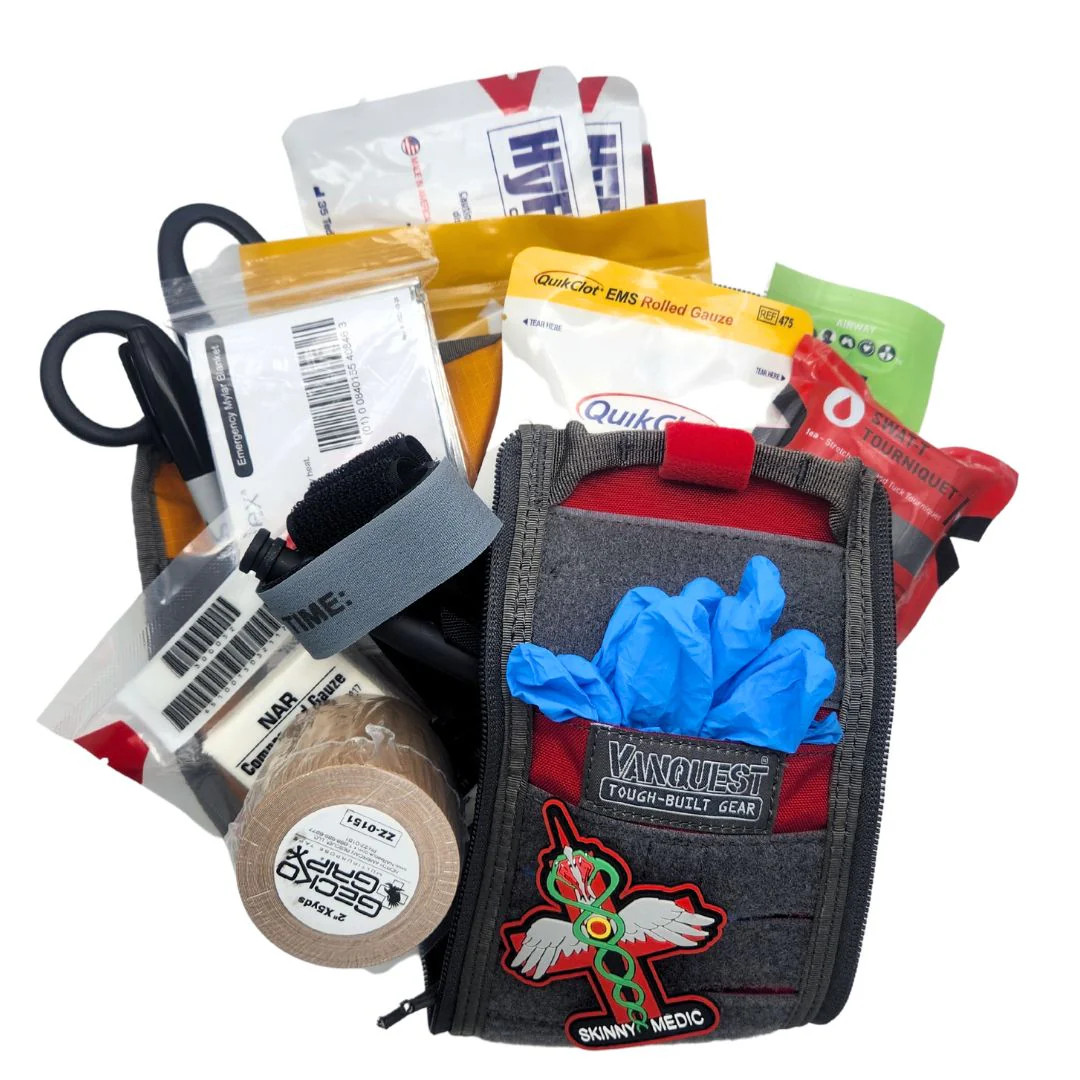
The individual first aid kit — IFAK — is the centre of the catalogue and the correct first purchase for most buyers. The concept comes straight from military and emergency medicine: a compact, one-casualty kit organised around the treatable causes of preventable death, with massive bleeding at the top of the list. A properly built IFAK carries a windlass tourniquet, hemostatic or plain compressed gauze for wound packing, a pressure bandage, gloves and shears — a short list of items that do the job, rather than a long list that looks impressive on a contents card.
The trauma kits scale that logic up: multi-casualty or multi-scenario builds for vehicles, homes, ranges and remote trips, where more dressings, airway adjuncts and chest-seal-type items earn their place for trained users. The buying logic we recommend is scenario-first — who is likely to be hurt, how far is help, what have you trained to use — and the range maps onto that logic well. A range bag needs bleeding control above all; a remote hiking kit adds wound care and environment; a home kit adds volume and the boring everyday items.
The caveat belongs in the same breath as the praise: every item beyond a bandage assumes a user who has practised. Buy the kit, then book the course — in the US, community bleeding-control and first-aid classes are cheap, short and widely available.
The rest of the range
Tourniquets & hemorrhage control
Sold individually as well as inside kits: windlass tourniquets of the professionally validated pattern, hemostatic gauze, compression dressings and wound-packing supplies. Buying these from a specialist matters more than any other line in the store — this is the exact product family where marketplace counterfeits have been documented, and where failure is not a refund conversation. Many buyers sensibly purchase a second tourniquet purely as a trainer, so the real one stays staged.
Kits by scenario: home, vehicle, range & field
Purpose-built kits for the places injuries actually happen: car crashes witnessed on a commute, range incidents, hunting and backcountry mishaps, and home emergencies. The differences between them are thoughtful rather than cosmetic — vehicle kits favour fast access and visibility, range kits are unapologetically bleeding-focused, field kits add wound care for the hours-from-help problem. Pick by scenario, not by size.
Components, refills & carry gear
Individual supplies — dressings, gauze, gloves, airway items, tape — plus pouches and mounting gear for staging. Component shopping is the underrated feature of a specialist retailer: kits get used one item at a time, and replacing that item beats retiring a whole kit. It also lets experienced users build custom loadouts that match their training exactly.
Price & value
Prices shift with builds, promotions and component costs, so read the following as an honest ballpark rather than a quote, and check live pages before budgeting. The structure of the market is stable, though: genuine hemorrhage-control gear carries real costs, and anything dramatically cheaper than the ranges below deserves suspicion rather than celebration.
| Category | Typical price (USD, approx.) | Notes |
|---|---|---|
| Quality windlass tourniquet | ~$30–$45 | Suspiciously cheap listings are the counterfeit red flag |
| Compact IFAK | ~$60–$150 | One-casualty bleeding-control core |
| Full trauma or family kits | ~$150–$400+ | Multi-scenario builds, more consumables |
| Refill components | ~$5–$40 each | Replace what you use; keep the kit alive |
| A bleeding-control course (for context) | ~$0–$100 | Often community-run; the best value line on this table |
Value verdict: strong, and the fair comparison is not against the twenty-dollar marketplace kit — that product solves a smaller problem. A properly built IFAK costs about as much as a family dinner out, stays staged for years with occasional refills, and covers the one emergency category where minutes decide outcomes. The honest accounting also includes a course fee: gear plus training is the product; gear alone is a talisman.
How to choose the right kit & get the best results
- Start from your scenarios, not from a product page: commute, range days, remote trips, kids at home — list where injury is plausible and how far help is.
- Put bleeding control first: whatever else a kit contains, a real tourniquet, gauze and a pressure dressing are the non-negotiable core.
- Match contents to training — buy what you can use today, and add advanced items only as your training grows into them.
- Stage kits where the injuries are: one kit in a cupboard protects a cupboard; the car, the range bag and the pack each need their own.
- Book a bleeding-control and first-aid course within a month of the kit arriving, and practise with a trainer tourniquet, not your staged one.
Then maintain the system: check kits twice a year, replace anything used or expired from the components range, and rehearse where everything lives so your hands know the layout under stress. A kit you have opened five times in practice is a different product from the identical kit still in shrink-wrap.
Common buying mistakes to avoid
The classic errors in this category are all judgment errors, not product errors. Buying by item count — a 300-piece box of plasters loses to a five-item bleeding kit in every emergency that matters. Buying tourniquets from the cheapest marketplace listing — the documented counterfeit problem makes this the one product family where saving fifteen dollars is genuinely reckless. Buying one kit for a whole life — emergencies do not queue politely at the hall cupboard; the car and the range bag need their own. Buying above your training — advanced airway and chest items in untrained hands are dead weight or worse. And the biggest one: treating the purchase as the preparation. The kit is the easy 20 percent; the course, the staging and the twice-yearly check are the 80 percent that make it real.
Watch: First aid kit essentials
Medical Gear Outfitters vs alternatives
Against My Medic, the most visible consumer brand in the space: My Medic’s strength is polished, beginner-friendly presentation and household-oriented kits, typically at a lifestyle-brand premium; a specialist like Medical Gear Outfitters counters with a more field-oriented catalogue and component depth for buyers who know what they want. Against North American Rescue, the professional benchmark whose components equip services worldwide: NAR is the gold standard for the parts themselves, and the best specialist retailers largely compete by assembling and ranging that class of component conveniently rather than by replacing it. Against generic marketplace kits, the comparison is the whole argument of this review: padded item counts, lookalike hardware and no supply-chain accountability — fine for scrapes, indefensible for hemorrhage. Shortlist the specialists, compare contents line by line, and let tourniquet provenance be your tiebreaker.
Quality, shipping & support
Quality in this category is a components question, and the right habit is to read contents lists like a sceptic: named, recognised tourniquet patterns; hemostatic products of the types used in emergency medicine; dressings with real dates. Specialist retailers live or die on getting this right, and the store’s trauma-first catalogue signals the correct priorities — but verify the specific components in the specific kit you buy, because that is where quality actually resides.
Shipping is conventional US e-commerce: carrier delivery of light, compact parcels, with the usual thresholds and promotions moving effective cost around. The only wrinkle is for international buyers, who should confirm both shipping availability and their own country’s import rules for medical supplies before ordering. Consumables carry expiry dates, so avoid stockpiling beyond what your refill cycle genuinely uses.
Support in the niche typically runs over email and contact forms, with the veteran and first-responder culture of the space showing up as practical, experience-flavoured product guidance — helpful for “which kit for this scenario” questions. What no retailer’s support desk can or should do is practise medicine: for anything clinical, the answer is a course instructor or a medical professional, and a good store in this space will tell you exactly that.
What real customers say
Buyer feedback in this niche follows a recognisable pattern, and reports around Medical Gear Outfitters appear to track it: praise concentrates on kit quality and thoughtful assembly, the reassurance of recognised components, and service that feels like it comes from people who use the gear — the veteran-oriented character of the space earns repeated positive mentions. The most affecting reviews in this category are the after-action ones: buyers who used a kit at a crash scene or a range incident and are writing with the particular sincerity of someone whose purchase was recently load-bearing.
Critical notes, where they appear, cluster on price versus the marketplace tier, occasional stock waits on popular components, and the navigation problem every deep catalogue has — new buyers unsure which kit is “the one.” In preparedness retail, enthusiasm sometimes outruns evidence in reviews, so weight the specific, scenario-described accounts over the vibes.
Who should buy — and who should not
Buy here if you fit the store’s obvious constituencies: range shooters and hunters, for whom dedicated bleeding-control gear is simply part of the sport’s equipment list; backcountry hikers, hunters and overlanders operating hours from help; and preparedness-minded households that want the car, the home and the pack each properly staged. Buy here too if you already have training — the component depth rewards people who know exactly what belongs in their loadout.
Look elsewhere — or at least start smaller — if what you actually need is scrape-and-splinter coverage for a kitchen drawer; a simple pharmacy kit does that for less, and nothing in this catalogue is aimed at you yet. And if you want the gear but refuse the training, the priority is backwards: a trained person with gauze and a belt outperforms an untrained person with a full trauma kit. Take the course first.
Honest limits
The limits to price in before buying: this is specialist gear at specialist prices, and the catalogue’s depth can disorient first-timers; stock on popular components ebbs and flows; international ordering needs homework; and consumables expire, so ownership includes a maintenance habit. Above all, the structural limit of the entire category: kits are supplies, not skills. Nothing sold here treats anyone — trained hands do — and this review is consumer guidance about equipment, not medical advice. For anything clinical, defer to a qualified instructor or medical professional.

Medical Gear Outfitters discount codes & deals
Preparedness retail runs promotions steadily — seasonal sales, bundle pricing on kits, and percentage codes that matter most on the bigger trauma-kit and multi-kit orders where families stage the car, home and pack in one purchase. Before checkout, look over our deals hub for the current verified Medical Gear Outfitters codes and offers; we verify what is live and cut what is dead so the code field does not become its own small emergency. One planning note: a discount is the right reason to buy the better kit, never the reason to buy a cheaper tourniquet — in this category, provenance outranks price every time.
Frequently asked questions
What is an IFAK, exactly? An individual first aid kit — a compact, one-casualty kit built around the treatable causes of preventable death, with bleeding control at its core. It complements, rather than replaces, a general household first-aid box.
Do I really need a tourniquet? If your scenarios include vehicles, tools, hunting or range time, uncontrolled limb bleeding is the emergency where minutes decide outcomes, and a tourniquet is the validated answer. It also assumes training — take a bleeding-control course.
Why not just buy a cheap kit online? For scrapes, fine. For trauma, the marketplace tier is padded with plasters and has a documented lookalike-hardware problem in exactly the components that must not fail.
Can I use this gear without training? Practically, training is what makes the gear work under stress — a short course transforms the value of everything in the box. This is general information, not legal or medical advice.
How often should I check my kits? Twice a year is a sensible rhythm: confirm contents, replace used or expired consumables from the refill range, and re-familiarise yourself with the layout.
Does Medical Gear Outfitters ship internationally? It is a US-focused retailer; international buyers should confirm shipping options and their own country’s import rules for medical supplies before ordering.
Are there discount codes? Promotions appear through the year, and the current verified offers are collected on the PrimeVouch deals hub — worth a look before any multi-kit order.
Matching your first-aid kit to your actual risks
The most useful exercise in all of preparedness costs nothing: sit down and write an honest list of the emergencies your household is statistically likely to meet, then build backwards from the list instead of forwards from a catalogue. For most families the list is unglamorous — road crashes seen or suffered on the commute, kitchen and workshop lacerations, sports injuries, a fall on a trail, and for shooting households, range incidents — and each entry implies a location, which is why staging beats stockpiling: one magnificent kit in the hall cupboard is worth less than three modest kits living in the car, the range bag and the pack, because emergencies happen where you are, not where the kit is. Each entry also implies a severity, and severity sets the contents — the kitchen list is served by a good pharmacy kit, while anything involving vehicles, tools, firearms or remote country puts hemorrhage control at the top and makes the tourniquet-gauze-pressure-dressing core non-negotiable. Then weigh distance from help, the variable people most often ignore: five minutes from an ambulance, your job is to keep someone alive for five minutes; two hours up a trailhead, your kit and your skills are the medical system, and both should be sized accordingly. Skills are the multiplier on every line of the list — a weekend first-aid course and a short bleeding-control class raise the value of every kit you own more than any upgrade you can buy, so put them on the same budget line as the gear. Review the whole system twice a year as your life changes — new baby, new sport, new commute — and let the list, never the catalogue, decide what comes next. Done this way, a modest, well-staged set of kits quietly outperforms an impressive one bought on impulse; risk-matched preparation is a game households win on paper before they ever open a product page.