
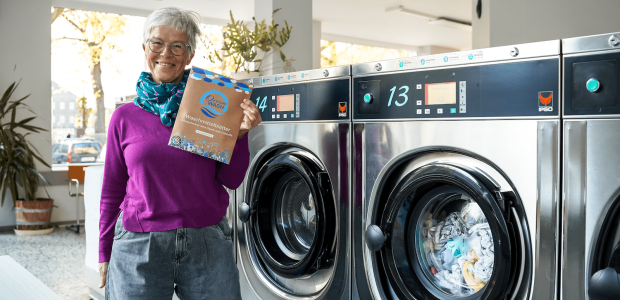

If you have landed here, you are probably asking one blunt question: do plastic-free laundry detergent sheets actually clean your clothes, or are you paying a premium for a feel-good story wrapped in cardboard? OceanWash is one of the most visible German eco brands in this category, and the honest answer is nuanced. For everyday laundry, the sheets clean well, cut plastic waste dramatically, and are genuinely convenient. For heavy grease, mud, and set-in stains, they ask more of you than a big-brand liquid does. This review walks through the whole range, the price question, and the biodegradability debate around PVA/PVOH film so you can decide with your eyes open.
PrimeVouch Score: 8.3 / 10
Best for: Environmentally minded households with soft-to-normal water and lightly-to-moderately soiled everyday laundry who want to eliminate plastic jugs and reduce clutter.
What we loved:
- Zero plastic bottle: sheets ship flat in a recyclable paper envelope, and a 64-wash pack weighs roughly 165 g.
- Pre-measured dosing with a divider line, so no overpouring and no sticky measuring cap.
- Clean formula: no microplastics, dyes, optical brighteners, bleach, parabens or phosphates; vegan and cruelty-free.
- A tangible impact hook: roughly 1 kg of ocean-bound plastic recovered per pack via rePurpose Global.
- Great for travel, small flats, and anyone tired of hauling heavy jugs home.
Watch out for:
- Weaker on tough, greasy, or set-in stains than a heavy-duty liquid or powder with a full bleach system.
- Higher cost per wash than budget supermarket detergent.
- The dissolvable film is PVA/PVOH, whose real-world biodegradability is genuinely debated.
- Occasional undissolved residue on cold, short, or heavily overloaded cycles.
What makes OceanWash different
Most laundry detergent is mostly water. When you buy a jug of liquid, you are paying to ship water around the country in a plastic bottle that then has to be recycled or, too often, is not. OceanWash strips that out. The active cleaning ingredients are concentrated and pressed into a thin, lightweight sheet, roughly the size of a dryer sheet, that dissolves in the drum. A full 64-wash supply fits in an envelope smaller than a sheet of A4 paper and weighs about as much as a chocolate bar.
That is the practical difference. The philosophical difference is the brand’s positioning as a German eco company that treats plastic reduction as the whole point rather than a marketing footnote. The packaging is paper. The formula deliberately excludes microplastics, optical brighteners, dyes, bleach, phosphates and parabens. And the signature promise is the ocean plastic angle: for every pack sold, OceanWash works with rePurpose Global to recover roughly one kilogram of plastic waste that would otherwise reach or remain in nature. rePurpose Global runs verified recovery programs that also create income for waste workers in heavily affected regions, so the claim is more substantive than a vague “we plant trees” line.
None of that would matter if the clothes came out dirty. They do not, for the loads most households actually run. But it is worth being clear about what you are buying: a concentrated, plastic-light, everyday detergent with a strong environmental story, not a stain-obliterating industrial cleaner.
The star product
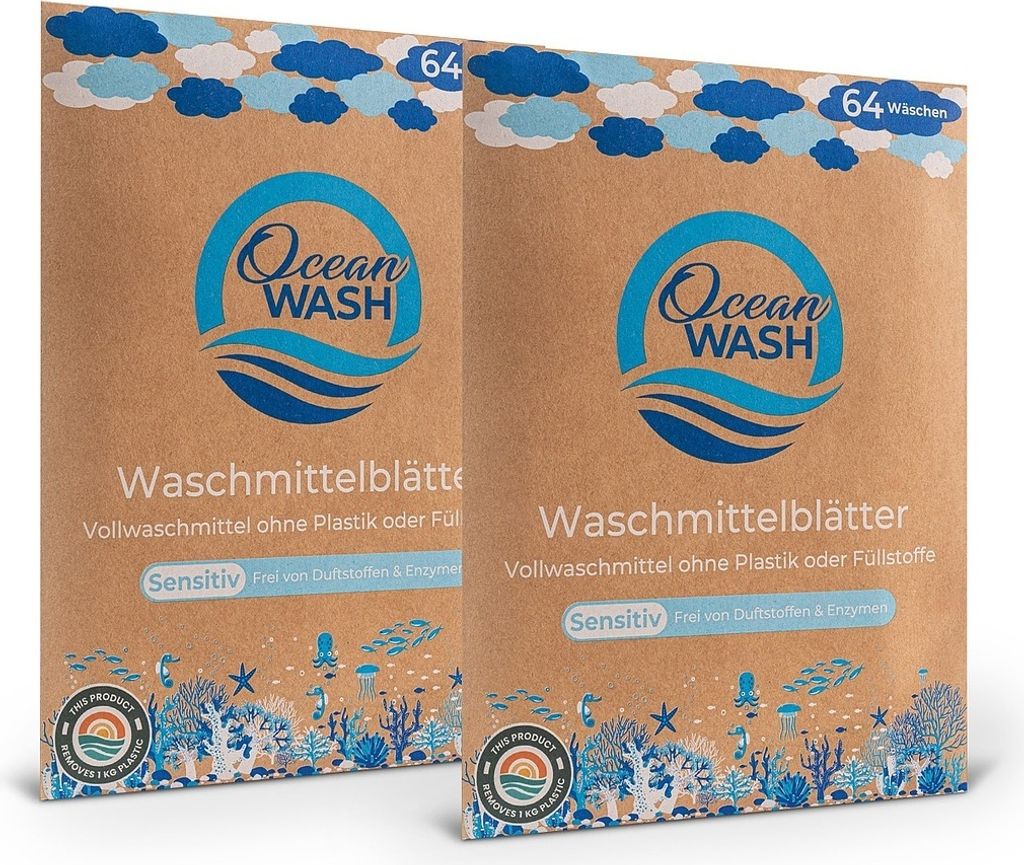
The laundry sheets are the reason OceanWash exists, and they are the product you should judge the brand on. A standard pack contains 32 sheets. Each sheet has a printed divider line down the middle, so one full sheet handles a normal 4.5 kg load and half a sheet handles a small or lightly soiled load. That gives you up to 64 washes per pack, which is where the “64 washes” figure comes from.
Using them is almost aggressively simple. You tear off what you need, drop it directly into the empty drum (not the dispenser tray), add your laundry on top, and run the cycle. There is no measuring cap to rinse, no drip down the side of a bottle, no gel pod bursting in a warm cupboard. For anyone who has ever knocked over a detergent jug or over-dosed a load into a stiff, itchy mess, the pre-portioned format alone is a quality-of-life upgrade.
On performance: for lightly and moderately soiled everyday laundry, shirts, underwear, bedding, towels, gym clothes, the sheets clean at a level most people will find indistinguishable from their old mainstream detergent. Colours stay bright because there are no optical brighteners faking it, and there is no perfume overload. The scent options are restrained rather than “spring meadow assault.”
Where they show their limits is at the hard end of the stain spectrum. Ground-in mud, motor oil, old red wine, collar grime, and greasy food stains are tougher for a bleach-free, brightener-free sheet than for a heavy-duty liquid with an enzyme-and-bleach system. You can close most of that gap by pre-treating stains and washing warm rather than cold, but if your laundry is routinely filthy, this is a genuine consideration, not a nitpick.
Check current OceanWash pricing
The rest of the range
OceanWash has expanded beyond the flagship sheets into a small but coherent home-cleaning lineup built on the same plastic-free, concentrated philosophy.
Dishwasher pods
The dishwasher tabs extend the plastic-reduction idea into the kitchen. They are formulated to skip the harshest additives while still cutting grease and drying without a heavy chemical film. As with the laundry sheets, they perform best when you do not overload the machine and when your dishes are scraped rather than caked. On genuinely burnt-on pots you will still occasionally reach for a manual scrub, which is true of most eco-leaning dishwasher products.
Cleaning range
The broader cleaning line follows the concentrate-and-reduce-packaging model, aiming to replace an under-sink shelf of single-use plastic spray bottles with something lighter and refillable. If you have already switched your laundry to sheets, consolidating your surface and multi-purpose cleaning with the same brand is a reasonable way to keep the plastic-free habit consistent across the home.
Scents and sensitive options
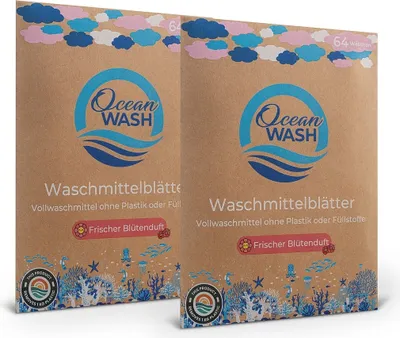
Beyond the standard fresh sheet, OceanWash offers scented variants, floral and cotton being the recurring options, plus a sensitive version aimed at people who react to fragrance. The sensitive route is the safer default for babies, eczema-prone skin, or anyone who simply prefers laundry that smells like nothing. Fragrance is one of the more common irritants in any detergent, so the unscented sensitive line is a meaningful choice rather than a token one.
How to choose / get the best results
Getting the most out of OceanWash is mostly about matching the format to how sheets behave, because they are not identical to liquid.
- Place the sheet in the drum, not the drawer. Detergent sheets are designed to dissolve in direct contact with water and tumbling laundry. Dropped in the dispenser tray they can clump or dissolve incompletely.
- Match dose to load. Use a full sheet for a normal to full load, half a sheet (along the divider line) for small or lightly soiled washes. Overloading the drum is the single most common cause of residue.
- Warm water helps. Very cold, very short cycles give the sheet less time and energy to dissolve. If you see white residue, nudge the temperature up or lengthen the cycle before blaming the product.
- Pre-treat the hard stains. Because there is no bleach or optical brightener, greasy and set-in stains benefit from a dab of stain remover or a short soak first.
- Choose sensitive if in doubt. For sensitive skin, babies, or fragrance avoidance, start with the unscented sensitive sheet.
Do these five things and the vast majority of “it left marks” or “it didn’t clean” complaints disappear. Most negative experiences with detergent sheets trace back to cold-and-crammed cycles rather than the formula itself.
Watch: OceanWash in action
OceanWash vs alternatives
OceanWash sits in a crowded field. Here is an honest side-by-side of the three routes most shoppers weigh up.
| Factor | OceanWash sheets | Generic detergent sheets | Mainstream liquid / pods |
|---|---|---|---|
| Plastic packaging | None (paper envelope) | Usually none | Plastic jug or plastic pod wrap |
| Everyday cleaning | Strong | Variable by brand | Strong |
| Tough / greasy stains | Fair (pre-treat) | Fair to weak | Strong |
| Cost per wash | Premium | Low to mid | Low (budget) to mid |
| Environmental extras | Ocean plastic recovery via rePurpose Global | Rarely any | Rarely any |
| Dissolvable film | PVA/PVOH (debated) | Often PVA/PVOH | Pods use PVA/PVOH; liquids none |
The pattern is clear. Against cheap supermarket liquid, OceanWash trades a bit of stain-fighting muscle and a higher price for near-total plastic elimination and a real environmental contribution. Against other detergent sheets, its edge is brand consistency, the sensitive option, and the ocean plastic program rather than a night-and-day difference in the sheets themselves.
Price & value
This is where honesty matters most. OceanWash is not the cheapest way to wash your clothes. Concentrated eco detergent sheets, as a category, cost more per wash than value supermarket liquid or powder, and OceanWash is positioned as a premium brand within that category. If your only metric is cents per load, a bulk jug of own-brand liquid will win, full stop.
The value case is different and depends on what you are actually paying for. You are paying to remove a plastic bottle from every purchase, to fund roughly a kilogram of ocean plastic recovery per pack, to skip a shelf of chemicals you may not want against your skin, and to reclaim cupboard space and stop lugging heavy jugs. For a lot of buyers, especially those already spending on sustainable choices elsewhere, that premium is small and worth it. For a large family running many heavy, dirty loads a week on a tight budget, the maths is harder and it is fair to say so.
A sensible way to test value without overcommitting is to buy a single 64-wash pack, run it through a normal month of your real laundry, and judge for yourself before subscribing or bulk-buying.
See the latest OceanWash offers
Who should buy — and who should not
Buy OceanWash if you run mostly light-to-moderate everyday laundry, you want to eliminate plastic detergent bottles, you value a verifiable environmental contribution, you have limited storage or move around a lot, or you or your household react to the dyes, brighteners and fragrances in conventional detergent. In those situations it is an easy recommendation.
Think twice if your laundry is routinely heavily soiled (workwear, sports kit caked in mud, greasy trade clothing), you live somewhere with very hard water and short cold cycles, or price-per-wash is your single deciding factor. You can still make sheets work with pre-treatment and warmer cycles, but you will be working a little harder than a heavy-duty liquid would ask of you, and paying more for the privilege.
Honest limits
Three caveats deserve to be stated plainly rather than buried.
First, stain performance. A bleach-free, optical-brightener-free sheet will not match an industrial-strength liquid on the worst stains. That is a formulation choice, not a defect, but it is real.
Second, residue. On cold, short, or overloaded cycles, some users report occasional white residue or an under-dissolved sheet. This is largely fixable with warmer water, correct dosing, and not cramming the drum, but it is a legitimate friction point compared to a foolproof liquid.
Third, and most important for a brand that leans on green credentials, the film. OceanWash sheets, like most detergent sheets and dishwasher pods on the market, rely on a water-soluble polymer, PVA (polyvinyl alcohol, also written PVOH), to hold the concentrate together and dissolve in the wash. PVA dissolves in water, but “dissolves” is not the same as “biodegrades.” There is an active scientific and regulatory debate about how completely PVA breaks down in real-world wastewater treatment versus passing through, and some research argues a meaningful fraction is not fully degraded. OceanWash is not unusual here, most of the category shares this ingredient, but if plastic-free purity is your absolute priority, you should know the film chemistry is the honest asterisk on every detergent sheet, this one included.
OceanWash discount codes & deals
OceanWash pricing shifts with bundles, multi-pack options, and subscription savings rather than constant flash sales, which is a good thing: no fake countdown timers pressuring you into a rushed decision. The most reliable ways to pay less are to buy a multi-wash bundle, combine the laundry sheets with the dishwasher or cleaning range in one order, or subscribe if you have already confirmed the sheets suit your laundry. We keep the current live offers and any active codes updated at the link below, so it is worth checking before you buy rather than paying full single-pack price.
Frequently asked questions
How many washes do you really get per pack?
A standard pack has 32 sheets, and each sheet has a divider line so it can be split. A full sheet covers a normal 4.5 kg load and half a sheet covers a small or lightly soiled load, giving up to 64 washes. If most of your loads are large and full, treat 32 as your practical minimum and 64 as the light-load ceiling.
Do the sheets actually dissolve, or do they leave residue?
They dissolve reliably when placed directly in the drum, dosed correctly, and run on a normal cycle with enough water. Residue complaints almost always come from very cold or very short cycles, overloaded drums, or putting the sheet in the dispenser drawer instead of the drum. Fix those and residue disappears.
Are OceanWash sheets safe for sensitive skin?
The formula skips dyes, optical brighteners, bleach, parabens and phosphates, and there is a dedicated sensitive/unscented option. That makes it a reasonable choice for fragrance-sensitive or eczema-prone skin. As with any new product, do a small test load first if you have known sensitivities.
Is the PVA film really eco-friendly?
PVA dissolves in water, but there is genuine scientific debate about whether it fully biodegrades in wastewater treatment. OceanWash is in the same boat as nearly all detergent sheets and dishwasher pods on this. It is a legitimate open question, and we would rather flag it than pretend the film is a settled non-issue.
Can OceanWash handle tough stains?
For everyday dirt, yes. For heavy grease, mud, and set-in stains, it is fair rather than excellent because there is no bleach or optical brightener. Pre-treating stains and washing warm closes most of the gap.
Is it more expensive than normal detergent?
Yes, per wash it costs more than budget supermarket detergent. You are paying for plastic-free packaging, a cleaner formula, and the ocean plastic recovery program. Whether that premium is worth it depends on how much you value those things.
What is the ocean plastic claim, exactly?
For every pack sold, OceanWash partners with rePurpose Global to recover roughly one kilogram of plastic waste from nature, through verified programs that also support waste workers in affected regions. It is a genuine, third-party-run contribution rather than a vague gesture.
How laundry detergent sheets actually work
It helps to understand why a paper-thin sheet can replace a cap of thick liquid. Conventional liquid detergent is a suspension of surfactants, enzymes, builders and fragrance in a large volume of water, typically well over half the bottle by weight. That water does no cleaning; it is a carrier that makes the product pourable and, incidentally, heavy to ship and reliant on a plastic bottle.
A detergent sheet removes almost all of that water. The active ingredients, the surfactants that lift grease and lift dirt away from fabric, plus the components that give the sheet structure, are dried and pressed into a thin solid film. When the sheet hits water in the drum and starts tumbling with your laundry, the film dissolves and releases those actives into the wash, where they do exactly what the liquid version would. The water you removed at the factory is simply added back, for free, by your washing machine.
The trade-offs follow directly from that design. Because the format is dry and concentrated, it ships light and needs no plastic bottle, which is the whole environmental appeal. Because it relies on a water-soluble film to hold together, it introduces the PVA question. And because eco sheet formulas typically leave out bleach and optical brighteners, they clean everyday laundry cleanly but ask for a little help on the worst stains. Understanding this mechanism is the fastest route to using OceanWash well: give the sheet water, warmth, movement and room, and it behaves like the detergent you are used to, minus the jug.
If the trade-offs make sense for your household, OceanWash is one of the more credible, honestly positioned options in the category.